
Q & A Shows
05/29/14 Full Show
You are listening to the Scott Horton Show. 05/29/14 Full Show
05/28/14 Full Show
You are listening to the Scott Horton Show. 05/28/14 Full Show
The Stress Blog
Today: Peter Van Buren, Mitchell Prothero, Sheldon Richman 12-3 eastern
Today: Peter Van Buren, Mitchell Prothero, Sheldon Richman 12-3 eastern time http://lrn.fm http://scotthorton.org/chat
Today: Michael Scheuer, Grant F. Smith, and Gareth Porter 12-3 Eastern
Today: Michael Scheuer, Grant F. Smith, and Gareth Porter 12-3 eastern time http://lrn.fm http://scotthorton.org/chat
Recent Episodes of the Scott Horton Show
4/11/24 Patrick Macfarlane: The US Is on the Path to War with China
Patrick Macfarlane joined Scott on Antiwar Radio this week to discuss America’s march to war with China. They talk about the provocative US maneuvers off of China’s coast and Washington’s ongoing effort to bring India into this new Cold War.
Discussed on the show:
- “‘Integrated Deterrence’ Means Provoking China” (Libertarian Institute)
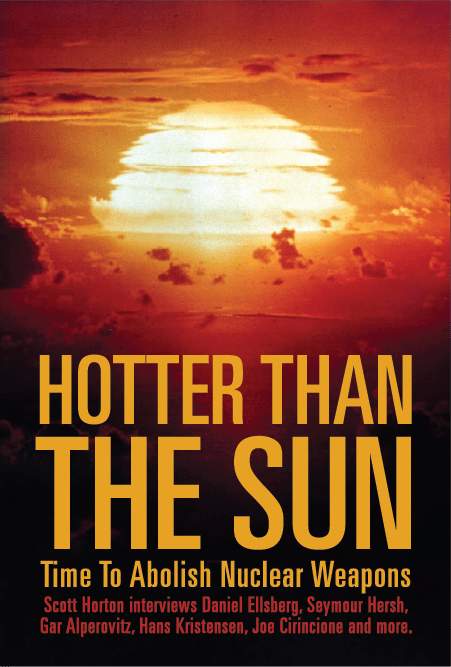
- Hotter Than The Sun: Time To Abolish Nuclear Weapons by Scott Horton
- Perils of Dominance: Imbalance of Power and the Road to War in Vietnam by Gareth Porter
- “US, Philippines, Japan, and Australia Conduct First Joint Military Exercise in South China Sea” (Antiwar.com)
Patrick MacFarlane is the Justin Raimondo Fellow at the Libertarian Institute where he advocates a noninterventionist foreign policy. He is a Wisconsin attorney in private practice. His work has appeared on antiwar.com and Zerohedge. Follow him on Twitter @patmacfarlane_
This episode of the Scott Horton Show is sponsored by: Roberts and Robers Brokerage Incorporated; Tom Woods’ Liberty Classroom; Libertas Bella; ExpandDesigns.com/Scott.
Get Scott’s interviews before anyone else! Subscribe to the Substack.
Shop Libertarian Institute merch or donate to the show through Patreon, PayPal or Bitcoin: 1DZBZNJrxUhQhEzgDh7k8JXHXRjY
Recommended reading



03/13/17 – Hope Hodge Seck on the howitzer-armed US Marines in Syria preparing to fight ISIS – The Scott Horton Show
Hope Hodge Seck, a writer for Military.com, discusses the deployment of Marines attached to the 11th Marine Expeditionary Unit (MEU) into Syria, and their preparation to provide artillery back-up to American supported militia fighters poised to attack the Islamic State stronghold in Raqqa.

Podcast: Play in new window | Download
03/13/17 – Chris Deliso on the foreign provocateurs exacerbating Macedonia’s political crisis – The Scott Horton Show
Chris Deliso, director of the independent Balkanalysis.com, discusses the three-year-long political crisis in Macedonia brought about when a consortium of internal and external agitators tried to replace the long-ruling conservative party. These agitators included Macedonia’s leftist Social Democrats, Albania’s prime minister, European intelligence agencies, George Soros’s Open Society Foundation, and the US Ambassador to Macedonia.
Podcast: Play in new window | Download
03/13/17 – Jacob Hornberger on upcoming FFF events including ‘End the War on Drugs’ conference – The Scott Horton Show
Jacob Hornberger, president of The Future of Freedom Foundation, discusses his effort to educate more African-American college students about the evils of the war on drugs, since they are disproportionately effected by racist drug laws, yet typically make up a small part of his lecture audiences.
Upcoming FFF events:
End the War on Drugs – free program at Florida A&M University College of Law on Wednesday, March 22, 2017.
The National Security State and JFK – $99 admission to “one of the most fascinating, important, and relevant conferences” in FFF’s 27-year history. Guest speakers include director Oliver Stone and Ron Paul. The conference is Saturday, June 3, 2017 at the Dulles Airport Marriott in Northern Virginia.
Podcast: Play in new window | Download
03/13/17 – Samuel Oakford on keeping count of the civilian casualties from international airstrikes in Iraq and Syria – The Scott Horton Show
Samuel Oakford, an investigative journalist and contributor to Airwars.org, discusses the grossly underreported official number of civilians killed by coalition and Russian airstrikes in Iraq and Syria in the ongoing fight against ISIS; and why the Airwars estimates are much more realistic.
Podcast: Play in new window | Download
03/13/17 – Cynthia Storer on the Trump administration’s (mis)understanding of Islamic extremism – The Scott Horton Show
Former CIA terrorism analyst Cynthia Storer discusses the credentials of Sebastian Gorka, President Trump’s deputy advisor on national security affairs, who claims to be an expert on Islamic terrorism; Cynthia’s earlier CIA work tracking Osama bin Laden and warning about Al-Qaeda’s intent to target the US; and why labeling the Muslim Brotherhood a terrorist organization would be a stupid thing to do.
Podcast: Play in new window | Download
03/12/17 – Joost Hiltermann on Trump’s deluded reasoning for ramping up the fight in Yemen – The Scott Horton Show
Joost Hiltermann, program director for the Middle East and North Africa at the International Crisis Group, discusses the Trump administration’s mistaken view that the Houthis in Yemen are an Iranian proxy-militia like Hezbollah in Lebanon. Hiltermann also debunks claims that Iran is allied with Al-Qaeda, and examines the clan-based divisions in Yemen, the country’s unique religious makeup, and what kind of political solution could end the war.
Podcast: Play in new window | Download
03/10/17 – Jason Ditz on the latest US troop deployments in Afghanistan, the Middle East and North Africa – The Scott Horton Show
Jason Ditz, news editor for Antiwar.com, discusses why a few thousand more US troops in Afghanistan won’t stop the steady loss of ground to the Taliban; President Trump’s deployment of troops all over the Middle East/North Africa to fight ISIS; and the official understatement of civilian casualties from US air strikes in Iraq and Syria.
Podcast: Play in new window | Download
03/10/17 – Zaid Jilani on Trump’s selection of Russia-hawk Richard Grennell for NATO ambassador – The Scott Horton Show
Zaid Jilani, a writer for The Intercept, discusses President Trump’s apparent concessions to critics accusing him of being soft on Russia, including his selection of Richard Grennell (who is in favor of arming Ukraine and leaving direct military confrontation with Russia “on the table”) for NATO ambassador, H.R. McMaster for national security adviser, and Nikki Haley for UN Ambassador.
Podcast: Play in new window | Download