Hey y'all, Scott here, check it out, I wrote a book.
It's called Fool's Errand, Time to End the War in Afghanistan.
Find out all about it at foolserrand.us, foolserrand.us.
Here's how to support this show.
First of all, you can donate to the Libertarian Institute at libertarianinstitute.org slash support.
Anybody who donates $50 or more to our fund drive there, you get a signed copy of Fool's Errand.
That's at libertarianinstitute.org slash support.
Also, check out scotthorton.org slash donate and patreon.com slash scotthortonshow.
If you're trying to incentivize me to do more interviews all the time than you donate per interview, there is the deal at patreon.com slash scotthortonshow.
And also, hey, if you read the book and you like it, give me a good review on Amazon.
If you like the show, give me a good review on iTunes or Stitcher or wherever you do things like that.
And thanks.
Now listen to this.
Wall is the improvement of investment climates by other means.
Clausewitz for dummies.
The Scott Horton Show.
Taking out Saddam Hussein turned out to be a pretty good deal.
They hate our freedoms.
We're dealing with Hitler revisited.
We couldn't wait for that Cold War to be over, could we?
So we can go and play with our toys in the sand.
Go and play with our toys in the sand.
No nation could preserve its freedom in the midst of continual warfare.
Today, I authorize the armed forces of the United States in military action in Libya.
That action has now begun.
When the president does it, that means that it is not illegal.
I cannot be silent in the face of the greatest failure of arms in the world today.
My own government.
All right, you guys, introducing Andrew Coburn.
He is, of course, the author of Kill Chain.
Before that, Rumsfeld, his rise, fall, and catastrophic legacy.
And before that, a bunch of stuff about the Soviet Union, Iraq War, one and a half in the 90s, and all kinds of great stuff.
Here he has a brand new one in Harper's on the blog there.
Oh, he's the Washington editor at Harper's Magazine.
I think it's the oldest continuously published magazine in America.
I think I read that somewhere.
Probably at Harper's.
And this one is called Crime and Punishment.
Will the 9-11 case finally go to trial?
And you're not talking about Guantanamo Bay and the supposed criminal trials down there that are never gonna happen until the very last paragraph.
You're talking about the civil lawsuit against the state of Saudi Arabia.
Wow, and that's actually going to trial, huh?
Well, it looks like it's getting better.
I mean, without going through all the legal sort of maneuvering, for a long time, the Saudis said, oh, you can't sue us.
We've got sovereign immunity, thanks to the American law called the Foreign Sovereign Immunities Act.
So the 9-11 families and their lawyers, I mean, these are the widows and orphans and parents and survivors and victims and insurance companies.
They had the smart idea of getting Congress to change the law, which they did last year to the fury of the administration, and not to mention the Saudis.
And so Obama vetoed it, said this is a disgusting law.
You can't sue Saudi Arabia.
We don't want you to sue Saudi Arabia.
So he vetoed the bill, whereupon they had an override.
They got the Senate to vote 97 to one to override Obama's veto.
So that's the law.
Now they can sue Saudi Arabia.
So we're just now, they put in their complaint to the court.
The Saudi lawyers have answered with a motion to dismiss.
In November, the families and their lawyers or their lawyers get to answer that motion to dismiss.
Then there's oral arguments sometime in the winter.
And by spring, we might well be off and running.
Isn't that something?
Well, by the way, before we get too much further into this, just on that particular law, it seems worth pointing out that the Saudis have been running this dishonest campaign and even through cutouts, hiring American Army combat veterans to go to Capitol Hill to lobby against this thing based on the completely false claim that the language would allow for individual American soldiers, that the precedent would be set then, that individual American soldiers and Marines or sailors or whoever could be held responsible for war crimes, which by foreign powers.
Yeah.
Which is absolutely not in there, right?
This is about the civil culpability of not even individual Saudis, but of the Saudi sovereign state itself, correct?
Exactly.
It's complete garbage.
I mean, it's a real exercise in pleas.
I'm glad you mentioned it, but the Saudis through their lobbyists, the main lobbyists, lobbying firms, there's a firm called Corbett run by a guy called Michael Petruzella.
And they had, this is after JASTA had passed off to the veto override and everything.
And they were still trying.
They panned out.
They had about 70 subcontractors.
Most of the Republicans, as far as I can see, though it was bipartisan, but most of them were Republicans.
All around the country, they were recruiting veterans and they tell them, hey, there's this law that puts you personally in danger.
You could be sued for something you might have allegedly done in Iraq or Afghanistan.
And the veterans, there's a veterans advocacy group which wants to defend veterans.
And so if you like, we'll fly you free of charge to Washington and stay in the luxurious Trump hotel.
And then you just go up and lobby Congress.
And there was no mention at that point of Saudi Arabia.
I mean, these police guards claim there was, but they're clearly, everyone I've spoken to among the veterans agrees there wasn't.
And so they ate and drank Saudi government's expense at Trump Hotel.
And in fact, the first one group heard that the Saudis were involved was when one of the relevant lobbyists after a pretty liquid dinner, obviously, stood up and said, and I want you to know one thing, the Saudi government is not involved in this.
So they all thought, what?
The first they'd heard of the Saudi government.
So this was one particularly sleazy exercise to try and, for the Saudi government to try and protect itself.
Isn't that funny?
That sounds like a scene out of a TV show, you know?
Totally.
Between burps.
I want you to know that, you know, the Saudis have nothing to do with this and everybody's sitting there crickets.
What?
Saudis?
Yeah, yeah.
Man, and by the way, I wanna mention that Brian McGlinchey at 28pages.org has done great work on this, just as he did great work in getting, you know, helping to organize the effort to get the 28 pages declassified finally, which is a huge part of your story.
Absolutely.
Still on that one point, I still gotta go on though and say, that is some brilliant public relations there because, you know, soldiers and really kind of, you know, talk radio right-wingers who don't really read too much and don't really know that much, they could be very susceptible to the idea of, yeah, foreign governments coming in and, you know, the Obama government, you know, not stopping them.
And Hillary Clinton letting some foreign government come in just because you signed on the dotted line and did what Bush and Obama ordered you to do, now they're gonna come after you.
I mean, how convincing is that?
All you gotta be is told that once and you believe it if you're in that position, I think, you know?
Well, there's another aspect to it too, which is, you know, the JASTA law passed because the 9-11 families have, you know, unquestioned moral authority.
No congressman would dare vote against the 9-11 families, but the only other group in the country that has equal or, you know, comparable, maybe even superior moral standing is the military, of military veterans.
So it's quite clever in a way to think, you know, if you think they produced, you know, business executives or whatever, diplomats, I mean, that had all been tried to stop JASTA and had gone nowhere.
And someone thought, aha, maybe people will go for veterans.
Maybe congressmen, if they're lobbied by veterans, you know, that'll counter the families.
As McGlinchey showed, a lot of these soldiers were angry too because nobody told them that it was the 9-11 families who were behind this law.
They might've wondered, why would they be trying to get me sued, right?
That doesn't make sense.
Instead, as you said, it's completely spun as though Congress is trying to sacrifice all their enlisted men here or something like that, you know?
And so, yeah, a lot of them were really angry when they found out how they had been used.
They told McGlinchey, you know.
Oh, absolutely, absolutely, yeah, yeah.
All right, so now on the 28 pages, I wanna hear the Andrew Coburn version of the Saudi government's role in September 11th, the best you know, including the means, motive, and opportunity, and what really happened here.
Because of course, there's a million different theories in 9-11, and so we wanna know what yours is here.
Well, okay, I mean, all we have, we don't, you know, who ultimately made the decision, we don't know.
What we do know is, and remember, this is all, we're just looking at a piece of a puzzle.
I should preface it by saying the hijackers in their preparation for the attack, they were distributed around the country.
There were some in Florida, most of them were in Florida, in fact.
There were some in New Jersey, some in other places, and two in San Diego.
What we know about is the San Diego end.
So there's a huge blank canvas where we know, you know, we basically have no idea who they were in contact with, well, it's a little idea, but basically almost no idea about who they're in contact with in terms of Saudi agents and so forth.
In San Diego, you had two guys called al-Hazmi and al-Mahdar who arrived from a terrorist conference in Malaysia, and they first went to Los Angeles where they immediately made contact with a guy called al-Tuwaimi, who was employed at the Saudi consulate in Los Angeles.
And he was also, his sort of functional boss was really the Saudi Ministry of Islamic Affairs, which is important, and we'll come back to that later.
This guy also was the imam at a big local mosque which had been funded by the Saudi government, well, by a very senior Saudi prince, in fact.
They go and hang out at his mosque, and he obviously spends time with them.
Two weeks after that, a guy comes up from San Diego called al-Bayoumi.
Now, he's an interesting character.
He is a Saudi who came into the US on a student visa, but had shown no sign of any studenting.
We're talking about early 2000s now, okay?
So the hijackers arrive at the beginning of 2000.
Al-Bayoumi is living down in San Diego.
He has a job.
He's on the books of a local aviation company, which is owned ultimately by the Saudi Ministry of Defense.
He never shows up for work.
He just draws a salary.
So someone's just put him on the books just to give him an income.
He, on a particular day in February 2000, he gets a call from Mr. Touhami, the guy running the mosque and working at the consulate in Los Angeles, says, come on up to LA.
You know, I got a job for you.
We don't want you fed, but he summons him to LA.
So al-Bayoumi jumps in his car, drives up to LA, goes to see the guy in the consulate, Mr. Touhami.
They spend half an hour talking, after which al-Bayoumi gets back in his car, drives across LA to a Middle Eastern restaurant, passing many other Middle Eastern restaurants.
So if he had a yen for Middle Eastern food at that moment, there's plenty of places he could have stopped at.
And he goes to this restaurant, in which are sitting, among other people, the two future hijackers, Midar and al-Hassan.
Now, al-Bayoumi says that he, by accident, he heard them talking Arabic and he turned around and sort of opened a conversation.
And the next thing we know is that he had invited them to come and live in San Diego and he'd found them an apartment and he'd paid the first month's rent and he'd helped them open a bank account and he'd introduced them to a friend who'd helped them get fake driving licenses and showed them where they could take flying lessons.
Now, according to Mr. Bayoumi and the U.S. official commission, 9-11 commission, this could all be just coincidence.
He could just have happened to have bumped into them.
Very clearly, this was not the case.
Bayoumi went to this restaurant.
His assignment was to meet these guys and look after them.
So he takes them down to San Diego.
As I said, he found them a place to live.
He introduces them to various people around, including a guy called Sheikh, who was actually an FBI informant, who some allegedly didn't mention to the FBI, about these two young guys who turned up who were taking flying lessons and one of whom ended up living in his house.
For money, Bayoumi had a friend called Basnan and the FBI files from that time, so the FBI thought these were both Saudi intelligence agents.
Basnan's wife was getting checks from the wife of the Saudi ambassador in Washington, the wife of Prince Bandar, who was the ambassador then, and on one occasion, a big check from Bandar himself.
That's Mrs. Basnan.
She is then signing over the checks to Mrs. Bayoumi, and this totals in all $150,000.
Allegedly, this is for Mrs. Basnan's medical needs.
Anyway, she was giving it away to Bayoumi, the Saudi agent, and it's reasonable to assume these were going to Mr. Meddar and Mr. Hazmi.
I should mention that Bayoumi, he'd been on a salary of something like $800 a month for his no-show job at the Saudi-owned aviation company.
The moment he started taking care of the hijackers, he got an 800% salary increase.
It's such a coincidence, I don't think so, that he's being paid extra to help keep these guys in good shape.
But when the hijackers left town later that year, first one, then the other, his salary dropped again.
So this was obviously a special supplement for him to look after the hijackers.
That's the sort of, not everything, but that's the sort of direct, that's the Saudi connection.
There were a whole bunch of other questionable Saudis connected with the Saudi government who were also hanging out with those hijackers and doing them favors and helping them get around.
Like, for example, Mr. Tuami, the guy at the consulate, he had a driver, a guy who drove for him occasionally, who it seems was told off to go take the hijackers for tours, on little tours around the place, sightseeing tours.
He took them to the sea world.
So what we have is a picture of two guys who are indeed terrorists.
They arrive in a country they'd never been in before.
They don't speak the language.
They don't have much money with them at the time.
And yet in no time at all, they find they have a support network.
They have this guy finding an apartment, a guy finding them flying lessons, a guy taking them sightseeing.
Everything's, there's a support network, all of which is connected to the Saudi government.
They're all employees of the Saudi government in one way or another.
So that's the very convincing, and that's not, I could go on for quite a while longer, but that's some of the elements of that.
So that's one very important circumstantial part of the case for the Saudi role, official Saudi role in 9-11.
There's a background to it as well, however, because this is all, there's no question that Al-Qaeda was the operative organization to set the whole deal up, going back to bin Laden.
When Al-Qaeda was being set up, it was set up really sort of almost as part of, but certainly with the assistance of a number of charities.
I'm making quotation marks in the air when I say that, which were basically part of the Saudi government.
Things called, they were really, they weren't, you could hardly call them charities.
They were like missionary sort of, missionary organizations.
They were Wahhabi outreach.
If you remember, you have to go back to the founding of the Saudi state, where the Saudi royal family basically hooked up, made a deal with the founder of the Wahhabi sect, which is this miserable, puritanical, intolerant, repressive branch, really minor branch of Islam as well.
And the rest of Islam regardless was pretty weird sectarians.
And so the two have always been mutually supportive.
And the mission for the royals, for the Saudi family from the Wahhabis is, well, we'll support you, but you've got to help spread our ideology.
And the royals thought that was a good idea and a much better idea if it could be done somewhere else.
So they liked it for export only.
So they set up these organizations that's spreading the Wahhabi faith around the world, that's set up, and they are simultaneously, you can see from the name, are simultaneously setting up al-Qaeda.
I mean, it's very hard to tell where one ends and the other begins.
You know, it's like an organization inside the organization, particularly in the case of, a lot of it was run through the Saudi Ministry of Islamic Affairs.
And you'll find in any Arab country, a lot of Arab countries, they all have ministries about Islamic affairs, and their job is to deal with the jihadi.
It was true in Morocco, it was true in Tunis.
I mean, a lot of it came unstuck after the Arab Spring, but that's basically it.
So that was certainly true in Saudi Arabia, the Ministry of Islamic Affairs, its job was to deal with al-Qaeda.
And we have, so we have people associated with the Ministry of Islamic Affairs involved in San Diego, like Mr. al-Tuwaimi.
So you have a whole Saudi institutional background, sort of enabling and supporting what became the people, you know, the organization that attacked us on 9-11.
And you can see it very clearly in operation as a support network for these guys in San Diego.
I mentioned the piece, one other aspect of this, which hasn't gotten much attention in all the investigations over the years, which was among the people looking after the hijackers in San Diego was a guy called Anwar al-Awlaki, who was an imam, a preacher.
Actually, he was an American, American born.
He'd been born in New Mexico.
And he was a young guy, and he was making a name for himself as a sort of, as a preacher.
And he was hanging out constantly with the, Bayoumi introduced him, well, it's not clear who introduced him, but he was certainly very thick with these two hijackers.
He was, he's generally regarded as having been their spiritual mentor.
When later on, they moved to Virginia, Herndon, Virginia, sort of where they stayed until the final, you know, they got on the, for the final attack.
He, by this time had moved himself, he himself had moved to a mosque in Virginia.
And again, there were thicker thieves.
He helped find them an apartment.
You know, he was with them all the time.
That's been, you know, talked about quite a lot.
And he suggested, and he later on, he became quite famous, this Awlaki, to the point where Obama killed him.
If you remember, Barack Obama killed him with a drone attack in Yemen in 2011.
But the interesting point that people here haven't sort of paid much attention to is that Awlaki's boss really was a guy called Abdul Majid al-Zindani, who was in Yemen.
He's very well known, particularly in Yemen, as a very militant, hard-over, jihadi sheikh, who had worked very closely with Osama bin Laden in the 1980s, finding, funneling recruits for the war against the Soviets in Afghanistan, which means that he must also have been working very closely with the Americans, with the CIA.
He returned to Yemen after that war, or, you know, he was operating full-time in Yemen, but very, very close to the Saudis.
He had a university, a sort of militant sort of university for terrorists called Iman University, which was actually in Sana'a, which was financed by the Saudis.
He would go to Saudi Arabia all the time.
And he was Awlaki's spiritual mentor.
So there's a very close, at the very least, this guy was a very senior Saudi agent, and he was very close to Awlaki, who was actually working for him, working for one of his organizations, when he was hanging out with the terrorists.
So you have these multiple links to Saudi Arabia, sort of all across the hijackings.
I mean, there's other examples from what little we know of Florida, which isn't much.
There was a Saudi family who seemed to have been entertaining at their house.
Some of, you know, many of the hijackers who were down there, including Mohammed al-Attar, who was like the on-scene director of operations, who flew into, I think, the North Tower on 9-11, was the first plane to hit.
This Saudi family, who had been entertaining them, having parties for the hijackers, you can imagine what a hijacker party is like, you know, practice running into the wall or something.
Anyway, they, suddenly, two weeks before 9-11, this family suddenly disappeared.
I mean, it looks like they ran out of the house, leaving pretty much all their possessions behind, cars in the garage, you know, pool cleaners still on, all the things you'd normally do if you were going away for a week or so.
These people disappeared forever.
And, you know, something very curious went on there.
We don't know what.
So, you know, I think that, you know, there's no, no one has a bit of paper from the king of Saudi Arabia, or head of intelligence or something, saying, hey, let's find some guys to fly into buildings in New York and Washington and see what happens.
But the circumstantial evidence is very, very, very strong.
All right, hang on just one second.
Hey, guys, check it out.
You got to read this new book, No Dev, No Ops, No IT, by Hussain Badakchani.
It's on amazon.com.
It's all about how to run your IT business right.
Also read The War State by Mike Swanson about the early years of the military-industrial complex after World War II, and get his investment advice at wallstreetwindow.com.
And now, you also want to buy your medals at Roberts and Roberts Brokerage, Inc.
That's rrbi.co, rrbi.co.
Get your anti-government propaganda at libertystickers.com.
Get your book edited at 3tediting.com.
And now, back to the show.
So, yeah, I mean, you're raising a lot of questions with all this information, and still we don't know, I don't know what it means.
I mean, well, let me put it this way.
Wasn't it that Prince Bandar was the ambassador to the United States at the time, and then Prince Turki al-Faisal was the director of intelligence?
Do I have that right?
I'm going from memory.
Yeah, yeah, that's all true.
So, why'd they do it then?
I mean, I guess there are a couple of different options, but it seems like if you were Prince Bandar, you wouldn't do that unless Dick Cheney told you it'd be all right, right?
Yeah, I don't think that.
I mean, certainly not a truther and all that sort of mad, you know, Bush did it.
Well, you know what, though?
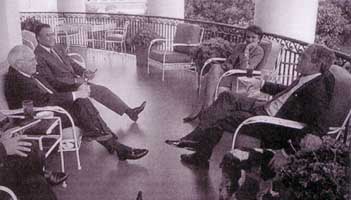
So, George Bush is smoking cigars on the Truman balcony with Bandar Bush three days later.
There's famous pictures of it.
So, what is going on?
What does it all mean?
Al-Qaeda, just like the Nazis with the FBI and the Oklahoma bomb, they just got away with it right under their nose, or what is it?
I think that there was, you know, the Saudi government, you know, it's not like, well, I don't know what our government is anymore, but it's not, you know, there was so many, there's so many fiber strands to it, including a whole sort of set of people, and, you know, very organizationally interwoven with it, who, you know, want to carry on the fight, who regard, you know, the U.S. as the great state.
And certainly at that time, that was certainly the case.
You know, they were, I mean, there's no other way to explain what happened.
There's no other way to explain how agents of the Saudi government set up Al-Qaeda.
I mean, the guy, he was a Saudi government official who set up Al-Qaeda in the Pacific region.
Another one helped set up the training camps in Afghanistan, with also with outreach to the Pakistani terror groups, you know, that attacked India.
You know, that's there, you can't question that.
I mean, it's, so, okay, you have to figure out why, why is this?
Why are elements of the Saudi government engaged in this?
And the answer has to be that, you know, the Saudi government is not a monolith, but that part of it, certainly at that time, you know, had an agenda, which was to, I know, to defeat American influence, to promote their own brand, to, you know, to basically do what, you know, Al-Qaeda does.
They believed in Al-Qaeda.
You know, that's clear that bin Laden had very, you know, all the time he was meant to be on the outs after he'd left Afghanistan, you know, the first time, or after he'd left Sudan, you know, had very close links with very high ranking people who were funding him.
So, you know, people say, oh, well, they, when people argue, oh, well, you know, it would be against the Saudi's interest to do this.
Why would they want to attack their ally?
We know, I mean, beyond a shadow of a doubt, it's in black and white that, you know, part of them, at least, were doing just that.
You know, otherwise, why are they helping to set up Al-Qaeda?
So, yes, of course, there's a question of, you know, precise motivations of what their plan was.
Seems like a hell of a risk, right?
They might've got Saudi invaded instead of Iraq.
Well, you know, that brings us to the, you know, the point you were referring to when you were talking about the, you know, Bandar al-Bush sitting on the Truman balcony, you know, the links between the US and Saudi Arabia.
I mean, don't forget, it's been going on ever since.
I mean, we still haven't invaded Iraq, sorry, we still haven't invaded Saudi Arabia, despite the fact that the Saudis have been financing the Taliban.
I mean, which we now know.
Well, and I think the last time we spoke, it was your piece about America backing the CIA and the Saudis working together to back Al-Qaeda in Syria.
Exactly, but at least Al-Qaeda in Syria wasn't attacking us at that time.
But, I mean, they were also, it turns out now, they were also financing the Taliban, who are attacking, or at least our forces in Afghanistan.
Well, you know, most of the guys were all veterans of Al-Qaeda in Iraq, so they'd fought Americans in Iraq War II, so that's close enough.
Yeah, so when people say, you know, which is the stock answer, oh, well, you know, as you just said, would the Saudis take that risk?
They take that risk continually, and it isn't much of a risk, nothing ever happens to them.
It's funny, because I could see a comic book where some general just arrests the president and bombs Riyadh, and just says, screw this, you know what, like, I'm not, no, we're not attacking Iraq, I overrule you, we're not gonna attack a country that didn't do it, we're gonna attack the country that did do it.
I mean, who's gonna stop them?
It seems like that they would be absolutely risking that, but as you say, yeah, you know.
Overall, bin Laden certainly thought it was worth it.
Bin Laden encouraged the invasion and long-term occupation of Afghanistan, no matter how many people died in it, as long as they win in 100 years is his way of looking at it, you know, gotta break some eggs to make an omelet, and all that kind of thing.
I mean, part of the answer is the question, which is, what is the real U.S.-Saudi relationship?
I mean, it's so much deeper and stronger.
I mean, you can point to, you know, I always talk about the arms sales, but there seems to be more to it than that.
I think a lot of it's sort of institutional habit, that our foreign policy establishment is so used to working with the Saudis, and, you know, their, well, you know, the Saudi relationship is something they all sort of, you know, that's part of their sort of permanent, it's hardwired into them.
So the idea of changing them and saying, well, to hell with them, you know, they are our enemy and we should be bombing Riyadh, not wherever else we happen to be bombing at the time, is, you know, it's just, they can't get their heads wrapped around it.
Well, and it seems like, I mean, you live there in D.C., I know you've been doing this journalism thing of yours for a long, long time.
Everybody, you gotta read the book, Rumsfeld.
I mean, read Kiltchain too, by all means, but Rumsfeld, man, you have to know what's in that thing.
So, you know, I guess there's no way to put a real number on this or anything, right?
It's a matter of quality, Andrew, but it seems like there is no real America lobby in terms of foreign policy in Washington, D.C.
It seems like the equal players are the American arms industry, the Israelis and the Saudis, and I guess the English to a degree, and then, you know, what, that's it.
So, in other words, you know, like Pat Buchanan said about Congress that it's Israeli-occupied territory, it's really all of D.C. is basically where foreigners come to spend money to control the Central Empire based out of North America in order to control their countries back home and get away with propping up their power and exploiting the rest of their people.
And, you know what I mean?
It's like Washington, D.C. is floating offshore.
It has nothing to do with the rest of us that live here.
It's this- Well, you can look at it another way just to kind of, you can look at it all as a protection racket, you know?
Yeah.
You know, Washington, D.C., and you say, okay, you know, you come and give us money in the form of lobbying fees or whatever, or else we'll, you know, I don't know, do away with your fishing rights or, you know, I don't know, do terrible, you know, exercise our power against you rather than for you.
I mean, there's one element which, you know, like think tanks.
I mean, if you want to see, you know, I think, you know, like Massachusetts Avenue, where a lot of them are, should be renamed the Red Light District because this is where all the policy prostitutes hang out.
You know, like the particular notorious one, the Atlantic Council, you know, which is in the pay, is paid for by, mainly, top of the list is the United Arab Emirates, but also the Saudis.
I think there's a bunch, but you know, it's basically, you know, it's a part of their agents of foreign influence.
I mean, in fact, there's a move, there's an excellent outfit called POGO, Project on Government Oversight that I'm connected with, but we're trying to get them to make it law that they have to register under the Foreign Agents Registration Act, you know, because they are lobbyists, just like the lobbyists do.
Well, I was going to say how surprised I was, really, to find out.
I mean, I guess I always grew up just fearing Rockefeller power and the Council on Foreign Relations and all of that sort of thing, but to think that, and of course, then there's WINEP and all of the, you know, pro-Israel groups and the Olin Foundation and all of that kind of, you know, the Axis of Crystal, you know, and all of that.
But to find out that you just have so many of these think tanks, the Middle East Institute and this, that, the other, there must be dozens of them that are really just outright outposts of foreign governments, completely financed by these sheiks from the Middle East, and then you get like Charles Lister, the white English expert who's here to tell you his objective expertise, but really he's nothing but a Muppet, basically, with a hand moving his mouth and he's representing the interests of Qatar or Kuwait or Saudi or whichever is his boss, you know?
I can't keep him straight.
Qatar in his case, yeah.
But no, so in other words, what do you mean they don't have to register as foreign agents?
What do you mean the think tanks themselves are outright backed by foreigners?
You would think that that would at least be, did there used to be a moray against that, if not a law, that the think tanks at least had to be financed?
I mean, even WINEP is not directly financed by the Israeli government, right?
It's financed by pro-Israel Americans.
Yeah, yeah, yeah.
You know, and we all know about AIPAC, but- Yeah, that's amazing.
They should be forced to register.
They should have the same restrictions, which I must say don't stop anyone doing much, but at least we should know.
I think every time an Atlantic Council person, goes to, has a meeting with someone from Congress or whatever they do, should have to report it.
The Middle East Institute, it turned out, had just taken, had managed to keep quiet about $20 million they got from the United Arab Emirates.
And yet they've been traditionally rather respected, one of the more respectable ones.
I think they should all just be done away with, actually.
I think that to have this, it's very dangerous to have this sort of fake object, they're like the sort of church or something, they're like churches dispensing objective wisdom, but they're not, they're all hookers.
Right.
All right, now, so back to our story here.
The Congress did an investigation before the 9-11 Commission.
It was a joint committee of the House and the Senate, I guess, Judiciary Committees?
Is that right?
No, Intelligence.
All right, sorry, yeah, I knew that and I don't know why I got it wrong.
Anyway, and then, so that was the 28 pages that's always referred to.
Then the 9-11 Commission came around and they never even looked at this angle at all.
And you talk about this in the article, a guy named Philip Zelikow was put in charge of the ultimate writing of that report.
And so how was he able to just omit this angle about Saudi support for the attack?
Or for the attackers, at least?
Well, he just did it.
He had, you know, he had very close links.
First of all, the Commission was headed up by two rather sort of feeble characters, former Governor Keene of New Jersey and former Congressman Hamilton from, get where he is from, Kentucky, I think.
And if you remember, if you've got a really long memory, you might remember Hamilton as the guy who was the co-chair of the Iran-Contra investigation, which basically managed to let this massive scattle go completely uninvestigated.
And, you know, getting into the Reagan administration got all scot-free, essentially, just because Hamilton is a very sort of weak read indeed and there's a pathetic character all around.
So now- Oh man, I'm sorry to interrupt, but I have to interrupt to say that when I was like a sophomore in high school, I read your wife's book, Out of Control, all about Iran-Contra.
And- There you go.
And so that's why I know so much about that.
And I still remember a lot of it.
And I got in trouble because I borrowed it from my history teacher and I put little check marks next to important paragraphs and stuff.
She got mad at me.
But anyway, so, yeah.
I'll get her another copy, yeah.
Excellent book, gotta recommend that.
Okay, yeah, Out of Control, Leslie Coburn.
That's right.
So anyway, so Hamilton and Keene, right, they're the in charge of the Commission.
They're the sort of co-chairs.
And they hire this guy, Zellico, which seemed to many people an odd choice because he was a close friend of Condoleezza Rice.
He'd worked on the Bush administration transition team.
He was sort of co-authored stuff with Rice.
He actually had written a paper, a sort of policy paper advocating preemptive war, which is what sort of excuse they use for invading Iraq.
So he was not really what you might call an objective fellow to be running this commission.
And it's not true that they didn't let anyone sort of think about Saudi Arabia at all, but it was very much discouraged.
There was one, I tell the story, and there was one, they'd hired a couple of people, not necessarily his idea, but they had hired a couple of investigators who'd worked on the congressional investigation who'd done a lot of work already on the Saudi connection, and they wanted to do more.
And they said, they did a memo saying, okay, we need to follow up on these things that we didn't have time before, these leads on the Saudi connection.
And he cut that back.
Then one of them actually got hold of the 28 pages, which was classified.
She had a security clearance, she had the clearance to read it, but because he'd not given it to her, he told her not to get it, he fired her.
So he was actually firing people for looking at the evidence of Saudi connection.
Right at the end of the 9-11 commission report, whenever the report was being drafted, the other, this guy called Mike Jacobson, who'd really uncovered a lot of the clues in San Diego, he heard, he got a tip, and he went round to the office at midnight and found Zelikow and a colleague, a sort of senior buddy of his, cutting out all the references to Saudi Arabia in the final report, which he proceeded to do.
And some of them were stuck in footnotes without Zelikow knowing.
So it was very much, the whole exercise had various objectives.
One was a really important cause to let the Bush administration off the hook and to let the Saudi Arabia off the hook.
Yeah, well you know, maybe I gotta admit that now, I was just thinking about how long ago it was that I was in high school and read that book and how old that means I am now.
A lot of people listening to this may not really be familiar, they might have been too young or just weren't paying attention then or whatever to remember just how blatant it was, how badly the government resisted doing the 9-11 commission at all.
And then as you say, they put in these two old pushovers so obviously, but only then after they tried to put Henry Kissinger in charge of the thing for crying out loud.
And then from the moment they put it together, Bush said, it was funny, it was like he was talking about, he was using lingo from when he was a governor talking about the education system.
And he's saying, this is an outcome-based commission.
Their purpose here is to make recommendations that we should create a new department of police state, that's all, go ahead and get to work guys, but this is the most Potemkin ridiculous thing in the world.
He basically said that in his lines, Karl Rove told him, get out there and tell them this is a sham, George, and they did.
Yeah, and it was, yeah.
It's incredible.
But thereafter, they said there's no evidence any senior Saudi official or the Saudi government was involved in 9-11.
And that then, that's become at the heart of all the judicial judgments, of all subsequent official investigations.
They had another one called the 9-11 Review Commission 10 years later.
So, the whole, if you stand back and think about it, which is what I hope people will do after reading my piece in Harper's, it's really amazing that this country is attacked.
Thousands of people are killed.
And what we do is, and we cover it up.
It's as if the Japanese attacked Pearl Harbor and the administration had gone to every possible length to let the Japanese off the hook, to say, oh no, it wasn't the Japanese, it was someone else, the Malaysian.
You know what, though?
Here's the problem, Andrew.
Lawyers.
And in fact, especially when you're talking about New York court cases about terrorism.
I mean, we've had these judgments blaming by, where they barely even pretend to come up with a rationalization for blaming Iran for 9-11.
Yeah, yeah, yeah.
And Lord knows that there's an entire industry in America built solely around, in fact, this is a growth industry, people.
You might consider getting in on this.
What you do is you blame Iran and Hezbollah for being ISIS and Al-Qaeda, and you just argue that it's all one big Islamic terrorism coming to get us.
Yeah, yeah, yeah.
And this kind of conflation.
So I wonder whether you think that it's possible that the people doing the suing here are actually, you know, have their heads screwed on straight and are gonna make sure to.
You know, in fact, I think even in your article, you talk about how, and I'm not sure if I have this right, I guess, that in their lawsuit, they're sort of blaming Saudi for backing Wahhabism and backing, you know, in a much more general sense, like inflating the religious belief with the actual Al-Qaeda terrorist movement.
And it seems like, I guess, you probably could get away with that in a New York court.
But on the other hand, it seems like it's almost missing the point from all the very, very specific stuff that you were saying before the case against them.
You know, Wahhabism is the problem.
This miserable sort of sect, you know, which is, you know, it seems to exist to impose regimes of social cruelty on wherever it holds sway.
I mean, ISIS is really, you know, ISIS is a Wahhabist operation, really.
In fact, when they set up the Islamic State and they took, you know, wanted to run the schools, they sent away to Saudi Arabia for school books, you know, so it's that close.
So it's, no, I wanna nail the Wahhabis too, I gotta say.
And I gotta say- Well, I'm just saying, I'm just saying, well, I don't know, it seems like inflating two different questions.
You know what I mean?
Like you could say that these Klansmen terrorists who murdered these black people believe in this weird right-wing sect of Christianity.
Let's focus on that and not the fact that here are these humans and their individual networks and their money and their plans and their conspiracy that they actually engaged in, which is the real deal.
You know what I mean?
I don't think you can understand why they did and how it was possible for them to do what they did without understanding, you know, without regarding them as part of the whole Wahhabi operation.
I guess I just figured, you know, I'm picturing a New York courtroom where the lawyers on both sides agree that the problem here is radical Islam.
And now they're talking about that and they're not talking about what happened anymore.
You know what I mean?
Or they're arguing a case that's so broad that maybe they don't even win it.
Well, if you can get the idea across to a jury that, you know, yes, it's radical Islam and by radical Islam, we mean Saudi Arabia.
I'd be happy with that.
Because that's what we do mean.
Yeah, but their lawyers are going to say on the other side that, yeah, but there are millions of Wahhabis and there's only tens of thousands of these terrorists.
Do you know what I mean?
It's not exactly a one-to-one correlation, is it?
Well, if you look at the Wahhabi ideology and, you know, whereas, you know, we don't need to discuss the fact that Islam is not about militant jihadism, but Wahhabism is.
Well, I know, but I mean, what you're doing is you're making the case for why the Saudis are mean to each other, not why any of them attacked the United States.
No, I'm making the case of why the Saudis feel it's their right and duty to be mean to the rest of it.
Anyway, but I will say the lawyers, the lawyers, I mean, they've got the lawyers involved in this, basically three, well, it's hundreds of lawyers, of course, but the three, the ones I've talked to, they have a, they've got a pretty sophisticated view of how it all works by now.
I mean, they've been, you know, they've been doing an amazing effort.
I'd hate to be, wouldn't you as a journalist hate to be doing the same story after 16 years?
And these guys have been living this case for 16 years.
Can you imagine?
Right.
Well, wait, so, but back to the previous point, though.
If H.W.
Bush never occupied Saudi to attack Iraq, and if Bill Clinton hadn't stayed there, and if, say, James Baker had told the Israelis, I mean it, get out of the West Bank, we're creating an independent state there, and this kind of thing, then you don't still think the Saudis would have been waging this terrorist war, the al-Qaeda or the Saudi government, or otherwise, right?
I mean, what business do they have to attack, they don't attack Canada.
You know what I mean?
No, because you have to, you're leaving something out, which is the fragility of the Saudi regime.
Remember, this all goes back to the deal between the Saudi family, the Saud family, and the Wahhabi, you know, the Wahhabist organization.
Yeah, no, I mean, I'm with you on all of this.
Factually, I'm just saying, but isn't it a leap to say they go from, they basically, you know, back these mosques all across the world to spread their sicko, right-wing version of Islam the way that they do, but conflating that with the actual terrorist networks themselves, when, I mean, you talked about how, yeah, they use those organizations as cover for all this money laundering and this and that, but then again, there's a lot more people participating in these mosques than there are participating in terrorist networks.
I mean, you know, let's move away from the Middle East.
Look at what's been going on in Indonesia, where they, you know, they poured money into the spreading Wahhabism there.
Yeah, but we're not talking about, again, we're not talking about spreading mosque, spreading Wahhabi mosques in America.
We're talking about crashing into American buildings and killing people in a massive attack, which is different than funding a mosque and the spread of a right-wing ideology.
It's the spreading of a war, of an attack on a foreign power.
In this case, one led to the other, you know.
You know, come on, Scott, look at Pakistan.
You know, they poured money in there, they set up these mosques, they paid for these mosques.
You know, they fertilized the sort of jihadi mentality, the jihadi infrastructure, you know, which leads, I defy you to find the separation point behind those, you know, what they got going in Pakistan and the suicide bombers of Lashkar-e-Taiba.
You know, it was all, you know, it all points to that.
I don't see, I mean, call me intolerant, but I don't, you know, I mean- I guess my point is, why doesn't Lashkar-e-Taiba attack the United States?
Because the United States doesn't attack Lashkar-e-Taiba.
We attack others near them, maybe, you know, I don't know.
Well, you know, it could happen.
I mean, wouldn't you argue that there's a distinction between al-Qaeda, international terrorists bent on attacking the United States versus local Afghan Taliban, backed as they may be by the Saudis, fighting to keep us out of their part of their district and their county where they live?
Yeah, I mean, that's true, fair point, but they, yeah.
I mean, in other words, you look at all the members of the Iraqi Sunni-based insurgency, or even all the members of the Sunni-based insurgency in Syria, and they're not all motivated by religious wackery.
They're motivated by politics and power and invasion and occupation.
They're certainly controlled by religious-based wackery.
I mean, it's- Well, what about the 9th Intifada in the West Bank?
Is that because of Saudi Wahhabism?
Well, it isn't yet, but it will be.
But you see what I mean?
The difference between, you know, an Arab doing something violent and also there's some Saudi money and mosques around, where like, I mean, yeah, there's some correlations here, but it's not all- Yeah, but what I will say is that, yeah, there's Arabs, you know, trying to attain their, just, you know, get their, fighting for just demands, but the pernicious thing is that more and more and more, I mean, to a huge extent, that is taken over by the religious wackery.
Well, sure.
Yeah, no, I mean, I don't deny that.
It's happened in Pakistan, it's happened in Afghanistan, it happened in Syria, although how everything got started in Syria is an interesting question.
You know, it's happening in, happened in Chechnya, happened in Kosovo, you know, it's just like this malignant sort of, you know, cancer that's spreading throughout the Islamic world, has spread through it, has spread throughout it.
All right, well, so, and then again, this goes back to the US, which is the Saudis, which is the world empire, and which is the Saudis' closest ally that lets them continue to get away with this.
And of course, as we talked about before with Syria, the Americans have been in on this really since, would you agree that the Iraq War II basically was an own goal, an accident, where they, not an accident that they did it, but they accidentally really empowered the Iranians, rather than getting a more powerful position versus the Iranians, they ended up empowering the Iranians.
So since then, they really switched back to the Saudis as hard as they could since, what, 2006 or seven, as Seymour Hersh put it, in the redirection.
And so now America's just, you know, this is the thing, I mean, they're really outright fighting with Zawahiri's guys, I mean, Zawahiri is still alive, and his guy, Jelani, and the Al-Nusra Front in Syria, they're still sworn loyal to him in a very literal way, right?
Yeah, yeah.
But this is the side that America's on.
They're not on our side, but we're on theirs.
Exactly so, I mean, you know, you couldn't make it up, but that's certainly the case.
Yeah, well, I think we can all predict it's gonna keep getting worse.
I mean, you know, the U.S. government, look, there's a thing I quote in the article, in that office piece, where Hillary Clinton sends around a memo, a cable, saying that Saudi Arabia is the principal source, significant source of funding for terror groups throughout the Middle East.
And then, you know, a little while later, there's another message on, you know, turned up in the Clinton archives that was leaked, which is her celebrating a $30 billion arms sale to Saudi Arabia, you know?
So it's, I don't know, it's very odd when you talk to these people in Washington.
I mean, you know, and I had people who were in the Obama administration say, tell me high-ranking people say, oh, we're fed up with the Saudis.
And that, you know, that interview that Obama did with the Jeffrey Goldberg in the Atlantic, where he, you know, he sounds off on the Saudis a bit.
And yet, you know, they're all there to kiss the ring.
You know, Obama, when he was campaigning, as I said in the piece, campaigner, candidate Obama, you know, was denouncing the Saudis as repressive and horrible and all the things they are.
And President Obama was also kissing the ring.
And I think he got rings as presents, in fact.
Certainly got a gold necklace like Trump did.
It's amazing.
Well, I mean, and when Trump went there, you talk about the big arms sales and how Trump was so impressed by the Saudis saying, oh yeah, we're gonna spend $110 billion on weapons, as though that should be the core of the American economy in the first place.
And all of our industry is simply making advanced weapons.
But then secondly, as William Hartung put it, almost immediately, yeah, this is not gonna be anything like $100 billion at all.
It might be 10 at the end of the day, you know, when there is actually.
But for our mark of a president, no problem.
Gave Trump a tweet.
Also, as I mentioned in the piece, what the people don't understand so well is that Trump has this, you know, to win in 2020, he feels he has to deliver for the economies of the Rust Belt states that elected him.
And so he was very excited.
I'm gonna have this on good authority.
He was very excited when the Saudis said, oh, we will invest in infrastructure projects, you know, roads and bridges and tunnels, in those states, you know, Michigan and Wisconsin and places.
And it was all part of his political plan.
I mean, it won't happen.
Because for a start, the Saudis don't have the money, but other good reasons too.
Yeah, well, and I guess Trump is just exactly the wrong kind of businessman if he really thinks that that's where real infrastructure investment has gotta come from, is from foreign states that we're blackmailing or are blackmailing us for whatever reason, you know?
Right, right, right, right.
Crazy.
Yeah.
All right, listen, I'm sorry, man.
I've kept you so long here, but thank you so much for coming back on the show, Andrew.
It's been great.
It was a pleasure.
All right, you guys, that's Andrew Coburn.
He's the Washington editor at Harper's Magazine.
Crime and Punishment, Will the 9-11 Case Finally Go to Trial?is brand new there at harpers.org slash blog.
Check that out.
It's also the spotlight today on antiwar.com.
And look at his books, Kill Chain, all about the drone wars, et cetera, and the terror wars.
It's really great.
And then before that, Rumsfeld, his Rise, Fall, and Catastrophic Legacy.
And I'm Scott Horton.
That's the show.
Thanks for listening.
Check out all the stuff at scotthorton.org, foolserun.us, and the Libertarian Institute at libertarianinstitute.org.
Thanks, guys.